


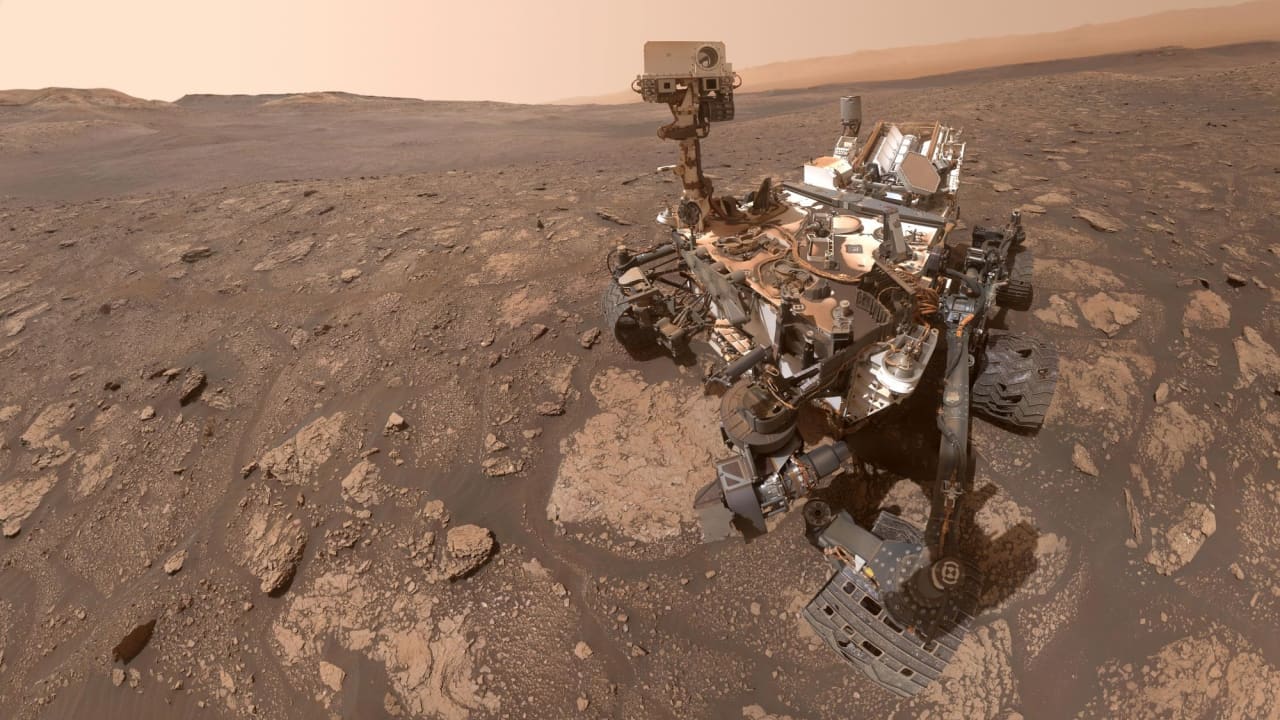
The Curiosity rover has revealed the most diverse array of organic molecules ever found on Mars, including seven previously unknown molecules on the Red Planet.
These carbon-based compounds are the same building blocks that enabled life to emerge on Earth.
The findings, published in the journal Nature Communications, come from a unique experiment on Mars in which the rover collected a rock sample and dissolved it in a chemical solution to unlock its composition.
The research team believes the organic molecules identified in the rock have been preserved on Mars for 3.5 billion years, according to Dr. Amy Williams, lead author of the study and associate professor of Earth sciences at the University of Florida, as well as a scientist on the Curiosity mission.
“These results are significant because they confirm that larger, complex organic molecules can be preserved on Mars across geological timescales, despite the harsh radioactive environment,” Williams said. “This supports the search for habitable environments on Mars, defined as places where life could have existed if it had existed.”
These findings complement Curiosity’s previous discoveries of organic compounds and reinforce the idea that Mars may have once been a habitable planet billions of years ago, rather than the frozen desert it is today.
“What this mission has revealed to me is not just that Mars was habitable, but just how incredibly habitable it was,” said Ashwin Vasavada, a co-author of the study and Curiosity project scientist at NASA’s Jet Propulsion Laboratory in California.
Searching for the ideal goal:
The Curiosity rover landed in Gale Crater on Mars in 2012 with the goal of determining whether the planet was ever habitable. For years, the rover climbed a feature known as Mount Sharp within the crater, searching for clay-rich layers that had been detected by orbiting spacecraft.
These clay layers, capable of preserving organic molecules, indicate that water not only existed on Mars in the distant past but also disappeared and reappeared at the site over time.
It took Curiosity about six or seven years to reach the clay layer in the Glen Torridon region of Mount Sharp, but the wait was worth it, according to Vasavada.
The rover found evidence of fossilized clay from ancient lakes, as well as sandstone formed by water flowing into those lakes.
The mission team then met to choose the best location to drill a sample to test for organic materials. Because the vehicle contained only two beakers for the wet chemistry experiments, the team wanted to make the most of the experiment, so they chose a site they named “Mary Anning,” in honor of the pioneering 19th-century British paleontologist.
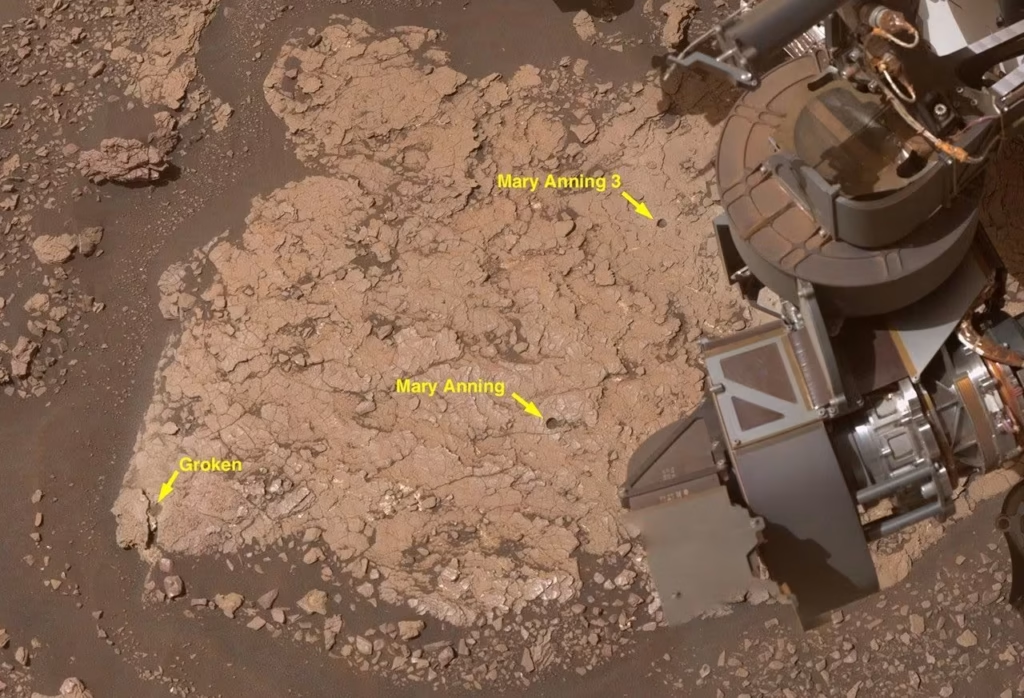
In 2020, Curiosity drilled a sample of sandstone containing clay minerals, crushed it, and placed it inside the Mars Sampler located in the center of the rover.
The team was able to identify 21 carbon-containing molecules, including nitrogen-containing cyclic compounds, which are precursors to RNA and DNA.
“This discovery is profound because these structures could be chemical precursors to more complex nitrogen-containing molecules,” Williams said. “Such compounds have never been found on the surface of Mars or confirmed in Martian meteorites before.”
The results also revealed the presence of benzothiophene, a carbon-sulfur molecule commonly found in meteorites, suggesting that such materials may have arrived on the planet via meteorite impacts.
Williams added, “The same materials that rained down on Mars via meteorites also rained down on Earth, and they may have contributed to providing the building blocks of life as we know it.”
Answering a profound question
Last year, Curiosity also discovered the largest organic molecules ever found on Mars, while the Perseverance rover detected leopard-spot patterns on rocks that could have been left by ancient life.
These discoveries together paint a fascinating picture of what Mars was like in the distant past, according to Vasavada.
This experiment also paves the way for future missions that will use similar chemical experiments to search for organic compounds throughout the solar system.
“Knowing how to conduct this type of chemical reaction on Mars for the first time was a huge achievement,” said study co-author Charles Mallesbehn. “Now that we have the experience, we are ready to apply similar experiments in future missions.”
This discovery is clear evidence that sedimentary rocks on Mars can preserve traces of organic materials that were present on its surface billions of years ago, according to Dr. Briony Horgan of Purdue University. She added, “Although we cannot yet definitively say that these organic materials are of life, we are beginning to gather data to answer this question. But to fully answer the question, the samples must be returned to Earth for laboratory analysis.”
Last January, Congress canceled an ambitious and costly plan by NASA and the European Space Agency to return samples from Mars, but scientists still maintain that this step is essential to answering one of the biggest questions in human history: Has life ever existed beyond Earth?
