


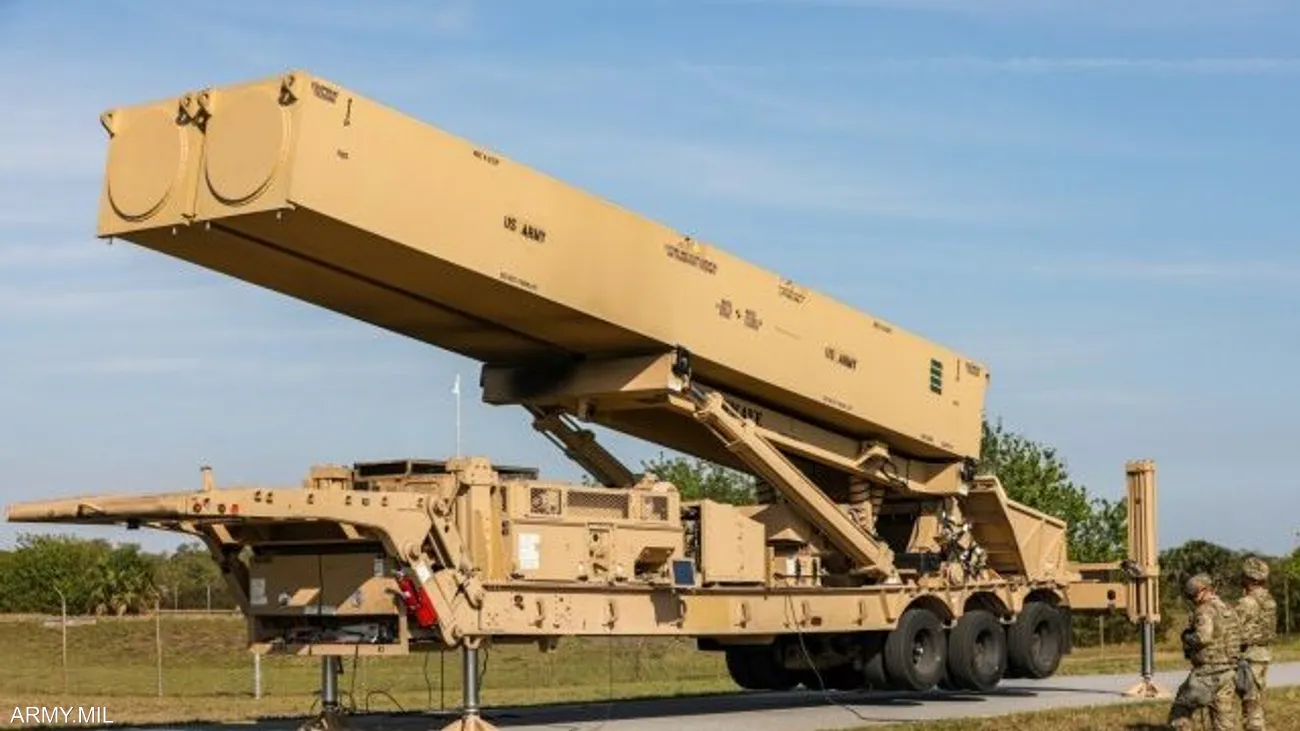
Bloomberg News reported that U.S. Central Command (CENTCOM) has requested the Department of Defense to deploy a Dark Eagle hypersonic missile to the Middle East for potential use against Iran. The aim is to establish a long-range missile system capable of targeting ballistic missile launch sites deep within Iranian territory.
If the Pentagon approves this move, it would mark Washington’s first actual deployment of its hypersonic missile, despite delays in its development and manufacturing. The missile has not yet been declared fully operational, and Russia and China have already deployed similar systems, according to Bloomberg.
An informed official stated that CENTCOM justified its request by arguing that Iran has moved its launch sites beyond the range of its current missiles, which have a range of 480 kilometers, thus reducing their effectiveness in targeting those sites.
Bloomberg reported that no decision has yet been made regarding the request, and CENTCOM declined to comment. The request indicates that Washington is preparing for the possibility of renewed strikes against Iran should President Donald Trump decide to proceed, despite the ceasefire that has been in effect since April 8.
The Axios news website reported that Central Command chief Brad Cooper would brief Trump on Thursday on new plans for any potential military action against Iran, given the stalled negotiations.
Bloomberg considered the Pentagon’s approval of deploying this weapon a message to strategic adversaries, primarily Russia and China, that the United States “is now capable of matching capabilities they have already developed.”
The Eagle, also known as the Long-Range Hypersonic Weapon, is believed to have a range exceeding 2,776 kilometers, although its precise capabilities remain classified. It is characterized by its ability to glide toward its target at more than five times the speed of sound, with maneuverability to evade interception systems.
Rocket Features :
The Dark Eagle missile was designed primarily to counter the advanced air defense systems of China and Russia. Manufactured by Lockheed Martin, each missile costs approximately $15 million, and only a limited number—no more than eight—are available, according to the source.
The U.S. Government Accountability Office (GAO) indicated that each battery of this system costs approximately $2.7 billion.
The United States had already deployed most of its stockpile of JASSM-ER stealth cruise missiles to the theater of operations with Iran, where approximately 1,100 missiles were launched during the conflict.
Despite Washington’s claims of achieving local air superiority in some areas of Iran, allowing its aircraft to operate without significant threat, the downing of dozens of MQ-9 Reaper drones, in addition to several manned fighter jets, indicates that other parts of Iranian airspace remain vulnerable.
